02 — Smart Contracts (Chaincodes)
The federated-governance-java package contains three Java chaincodes for Hyperledger Fabric 2.5+. Each is annotated with @Contract and implements ContractInterface. The default entry point is org.hyperledger.fabric.contract.ContractRouter.
1. ExperimentContractSmartContract
Annotation: @Contract(name = "ExperimentContractChaincode") @Default
Responsibility: manage the lifecycle of a federated experiment contract — from creation to closure — and the registration of the authorized training code.
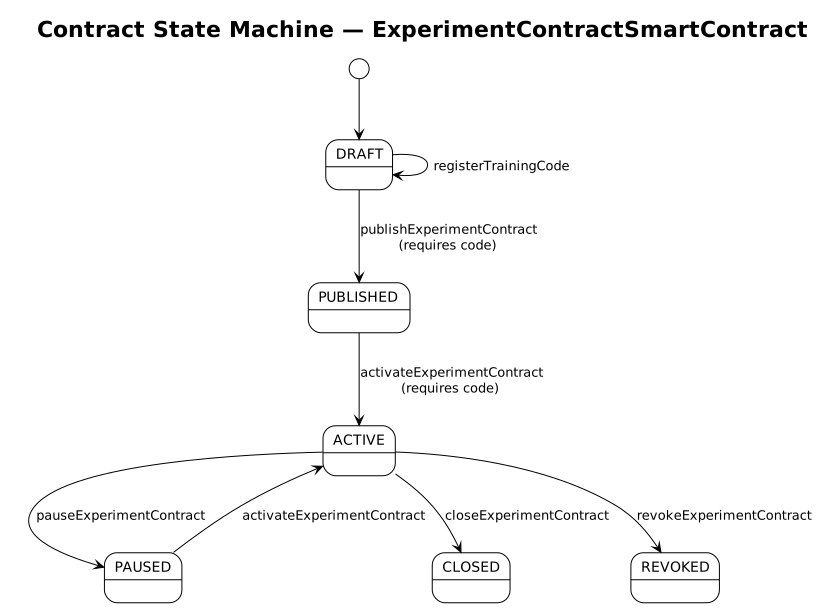
Contract state machine
Ver código-fonte PlantUML
    @startuml "ExperimentContractSmartContract — Contract State Machine"
    !theme plain
    skinparam shadowing false

    title Contract State Machine — ExperimentContractSmartContract

    [*] --> DRAFT

    DRAFT --> DRAFT : registerTrainingCode
    DRAFT --> PUBLISHED : publishExperimentContract\n(requires code)

    PUBLISHED --> ACTIVE : activateExperimentContract\n(requires code)

    ACTIVE --> PAUSED : pauseExperimentContract
    ACTIVE --> CLOSED : closeExperimentContract
    ACTIVE --> REVOKED : revokeExperimentContract

    PAUSED --> ACTIVE : activateExperimentContract

    @enduml
Valid transitions defined in requireAllowedTransition():
| Current status | Allowed next status |
|---|---|
DRAFT |
PUBLISHED |
PUBLISHED |
ACTIVE, CLOSED, REVOKED |
ACTIVE |
PAUSED, CLOSED, REVOKED |
PAUSED |
ACTIVE, CLOSED, REVOKED |
Operations
| Method | Type | Main parameters | Description |
|---|---|---|---|
createExperimentContract |
SUBMIT | experimentId, contractVersion, contractHash, contractUri, coordinatorId, validFrom, validTo | Creates the contract with status DRAFT. Fails if it already exists. |
registerTrainingCode |
SUBMIT | experimentId, contractVersion, codeHash, codeUri, signature, manifestHash, entrypoint | Registers the training JAR. Requires the contract to be in DRAFT or PUBLISHED. Only one code is allowed per version. |
publishExperimentContract |
SUBMIT | experimentId, contractVersion | DRAFT → PUBLISHED transition. Requires registered code. |
activateExperimentContract |
SUBMIT | experimentId, contractVersion | PUBLISHED → ACTIVE or PAUSED → ACTIVE transition. Requires registered code. |
pauseExperimentContract |
SUBMIT | experimentId, contractVersion, reasonHash | ACTIVE → PAUSED transition. reasonHash must have the sha256: prefix. |
closeExperimentContract |
SUBMIT | experimentId, contractVersion, finalReportHash | Closes the contract. finalReportHash must have the sha256: prefix. |
revokeExperimentContract |
SUBMIT | experimentId, contractVersion, reasonHash | Revokes the contract. reasonHash must have the sha256: prefix. |
getExperimentContract |
EVALUATE | experimentId, contractVersion | Returns the JSON of the ExperimentContractAsset. |
experimentContractExists |
EVALUATE | experimentId, contractVersion | Returns a boolean. |
Critical validations
contractHashandmanifestHashmust start withsha256:.- Code can only be registered while the status is
DRAFTorPUBLISHED(CONTRACT_IMMUTABLEif attempted after activation). - Each version accepts only one code (
TRAINING_CODE_ALREADY_REGISTERED). - Publication and activation require registered code (
TRAINING_CODE_REQUIRED). - Invalid transitions throw
INVALID_CONTRACT_TRANSITION. - The test dataset defined by the researcher stays in the off-chain document pointed to by
contractUri; the world state only records thecontractHash, which also covers theevaluation_datasetsection. - The test dataset policy must prevent distribution to clients (
researcher_only_never_to_clients).
Assets written to the world state
ExperimentContractAsset— composite key(experiment_contract, experimentId, contractVersion)TrainingCodeAsset— composite key(training_code, experimentId, contractVersion, codeHash)
2. ClientConsentSmartContract
Annotation: @Contract(name = "ClientConsentChaincode")
Responsibility: record a client's acceptance, rejection, or revocation for a specific version of the experiment contract.
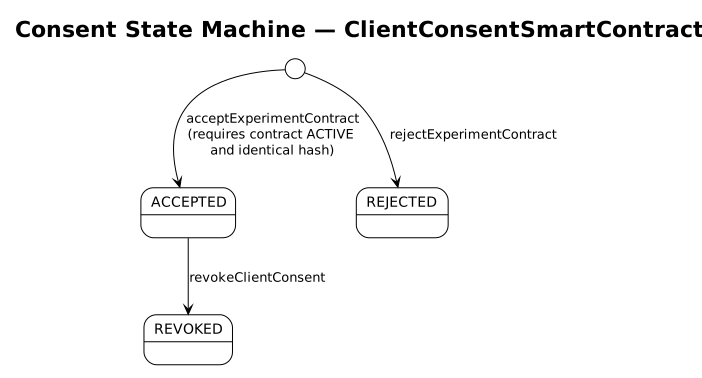
Consent state machine
Ver código-fonte PlantUML
    @startuml "ClientConsentSmartContract — Consent State Machine"
    !theme plain
    skinparam shadowing false

    title Consent State Machine — ClientConsentSmartContract

    [*] --> ACCEPTED : acceptExperimentContract\n(requires contract ACTIVE\nand identical hash)
    ACCEPTED --> REVOKED : revokeClientConsent

    [*] --> REJECTED : rejectExperimentContract

    @enduml
Compatibility: records written before the typo fix may contain
EXPCEPTEDin the world state. The chaincode accepts both on read (CONSENT_ACCEPTEDandCONSENT_EXPCEPTED). Every new write usesCONSENT_ACCEPTEDexclusively.
Operations
| Method | Type | Main parameters | Description |
|---|---|---|---|
acceptExperimentContract |
SUBMIT | experimentId, contractVersion, clientId, acceptedContractHash, signature | Accepts the contract. Requires the contract to be ACTIVE and acceptedContractHash == contract_hash on-chain. Writes ACCEPTED to the world state. |
rejectExperimentContract |
SUBMIT | experimentId, contractVersion, clientId, reasonHash | Records a rejection. reasonHash must have the sha256: prefix. |
revokeClientConsent |
SUBMIT | experimentId, contractVersion, clientId, reasonHash | Revokes acceptance. Accepts current status ACCEPTED or EXPCEPTED (legacy). |
getClientConsentStatus |
EVALUATE | experimentId, contractVersion, clientId | Returns a string with the status (ACCEPTED, REJECTED, REVOKED). Legacy records may return EXPCEPTED. |
getClientConsent |
EVALUATE | experimentId, contractVersion, clientId | Returns the full JSON of the ClientConsentAsset. |
listAcceptedClients |
EVALUATE | experimentId, contractVersion | Returns a JSON array with all client assets in ACCEPTED or EXPCEPTED (legacy) status. |
Critical validations
- For acceptance: the contract must be in
ACTIVEstatus (CONTRACT_NOT_ACTIVE). - For acceptance:
acceptedContractHashmust equal thecontract_hashof the on-chain contract (CONTRACT_HASH_MISMATCH). This guarantees that the client accepted the exact registered version of the contract. - For revocation: the current consent must be
ACCEPTEDorEXPCEPTED(legacy) (CONSENT_NOT_ACTIVEotherwise). - All required fields are validated (empty or null =
VALIDATION_FAILED).
Asset written to the world state
ClientConsentAsset— composite key(consent, experimentId, contractVersion, clientId)
3. FederatedExperimentSmartContract
Annotation: @Contract(name = "FederatedExperimentChaincode")
Responsibility: record immutable evidence of every execution step of the federated experiment: rounds, datasets, preflights, local updates, aggregations, and global models.
Call flow within a round
1. registerTrainingRound        (orchestrator — start of round)
2. registerDatasetEvidence      (client — local dataset evidence)
3. registerPreflightHash        (client — preflight result)
4. registerLocalUpdateHash      (client — hash of the submitted update)
   ... [repeated for each participating client]
5. registerAggregationHash      (aggregator — aggregation result with quorum)
6. registerGlobalModelVersion   (aggregator — candidate global model)
7. registerTrainingCompletion   (orchestrator — experiment closure)
Operations
| Method | Type | Main parameters | Description |
|---|---|---|---|
registerTrainingRound |
SUBMIT | experimentId, roundId, roundConfigHash | Registers the start of a round. roundId must be an integer. Produces an AuditEvent. |
registerDatasetEvidence |
SUBMIT | experimentId, contractVersion, clientId, datasetHash, metadataHash, recordCount, schemaVersion, dataPathHash | Registers local dataset evidence. Idempotent: a second call with the same values is accepted; divergent values are rejected. |
registerPreflightHash |
SUBMIT | experimentId, roundId, clientId, preflightHash | Registers the preflight result. Produces an AuditEvent. |
registerLocalUpdateHash |
SUBMIT | experimentId, roundId, clientId, updateHash | Registers the hash of the client's local update. Produces an AuditEvent. |
registerAggregationHash |
SUBMIT | experimentId, roundId, aggregationReportHash, quorumStatus | Registers the aggregation result along with the quorum status. Produces an AuditEvent. |
registerGlobalModelVersion |
SUBMIT | experimentId, modelVersion, modelHash, modelUri, promotionDecision, aggregationReportHash | Registers the candidate global model. modelVersion must be an integer. Rejects overwriting with divergent values. |
registerTrainingCompletion |
SUBMIT | experimentId, finalStatus, finalReportHash | Registers the closure of the experiment. Produces an AuditEvent. |
getDatasetEvidence |
EVALUATE | experimentId, contractVersion, clientId | Returns the JSON of the DatasetEvidenceAsset. |
getGlobalModelVersion |
EVALUATE | experimentId, modelVersion | Returns the JSON of the GlobalModelAsset. |
listAuditEvents |
EVALUATE | experimentId | Returns a JSON array with all AuditEventAsset records of the experiment, ordered by composite key. |
Critical invariants
DatasetEvidenceAssetis unique per (experimentId, contractVersion, clientId). A second call with the same data is accepted (idempotency). A second call with different data throwsDATASET_EVIDENCE_ALREADY_EXISTS.GlobalModelAssetis unique per (experimentId, modelVersion). Attempting to overwrite with a different hash or URI throwsGLOBAL_MODEL_ALREADY_EXISTS.- All
*Hashfields must have thesha256:prefix. roundIdandmodelVersionmust be valid integers (Long).
Assets written to the world state
AuditEventAsset— composite key(audit, experimentId, roundId, txId)DatasetEvidenceAsset— composite key(dataset_evidence, experimentId, contractVersion, clientId)GlobalModelAsset— composite key(global_model, experimentId, modelVersion)
Shared utilities (util package)
LedgerConstants
Defines all status constants and world state object types:
// Contract status
STATUS_DRAFT      = "DRAFT"
STATUS_PUBLISHED  = "PUBLISHED"
STATUS_ACTIVE     = "ACTIVE"
STATUS_PAUSED     = "PAUSED"
STATUS_CLOSED     = "CLOSED"
STATUS_REVOKED    = "REVOKED"

// Consent status
CONSENT_ACCEPTED  = "ACCEPTED"    // canonical value; every new write uses this
CONSENT_EXPCEPTED = "EXPCEPTED"   // @Deprecated — historical typo; kept for reading legacy ledger data
CONSENT_REJECTED  = "REJECTED"
CONSENT_REVOKED   = "REVOKED"

// Object types for composite keys
OBJECT_EXPERIMENT_CONTRACT = "experiment_contract"
OBJECT_TRAINING_CODE       = "training_code"
OBJECT_CONSENT             = "consent"
OBJECT_AUDIT               = "audit"
OBJECT_GLOBAL_MODEL        = "global_model"
OBJECT_DATASET_EVIDENCE    = "dataset_evidence"
StateKeys
Centralizes composite key creation via ctx.getStub().createCompositeKey():
| Method | Key components |
|---|---|
experiment(ctx, experimentId, contractVersion) |
(experiment_contract, experimentId, contractVersion) |
trainingCode(ctx, experimentId, contractVersion, codeHash) |
(training_code, experimentId, contractVersion, codeHash) |
consent(ctx, experimentId, contractVersion, clientId) |
(consent, experimentId, contractVersion, clientId) |
audit(ctx, experimentId, roundId, txId) |
(audit, experimentId, roundId, txId) |
model(ctx, experimentId, modelVersion) |
(global_model, experimentId, modelVersion) |
datasetEvidence(ctx, experimentId, contractVersion, clientId) |
(dataset_evidence, experimentId, contractVersion, clientId) |
Validation
Three kinds of validation, all of which throw ChaincodeException("...", "VALIDATION_FAILED"):
required(name, value)— rejects null or blank.requireHash(name, value)— callsrequiredand requires thesha256:prefix.requireInteger(name, value)— callsrequiredand requires a value parseable asLong.
Json
JSON serialization with no external dependencies (does not use Jackson). Methods:
object(Map<String,String>)— serializes a map as a JSON object.array(List<String>)— serializes a list of already-serialized JSON strings.withField(json, field, value)— replaces or inserts a field in an existing JSON string.field(json, field)— extracts a field's value by name.fieldEquals(json, field, expected)— compares a field's value.
In-memory simulators
For local development and testing without Fabric, each chaincode has a corresponding simulator:
| Real Fabric chaincode | In-memory simulator | Location |
|---|---|---|
ExperimentContractSmartContract |
ExperimentContractChaincode |
modules/federated-chaincode/ |
ClientConsentSmartContract |
ClientConsentChaincode |
modules/federated-chaincode/ |
FederatedExperimentSmartContract |
FederatedExperimentChaincode |
modules/federated-chaincode/ |
The simulators use ConcurrentHashMap instead of the Fabric world state. The same business invariants are enforced in both: state transitions, evidence uniqueness, idempotency. This ensures that local tests validate the same flows that the real Fabric network would execute.