04 — Integration with the System
This document describes how the blockchain layer connects to the other components of the HDT-AF project: the ledger operating modes, the two bridge implementations to Fabric (FabricGatewayLedgerMirror via the Gateway SDK and FabricCliLedgerMirror via the legacy CLI), the bridge-sharing mechanism across sessions (FabricExperimentBridgeContext), the configuration environment variables, and the chaincode deployment procedure.
Ledger modes
The federated-rest-api module (package br.ufma.lsdi.admin) supports only the BLOCKCHAIN ledger mode. Fabric is required, and failures block the operation:
| Mode | FEDERATED_LEDGER_MODE env |
Behavior |
|---|---|---|
BLOCKCHAIN |
blockchain (default), fabric; legacy launcher aliases are normalized to blockchain |
Fabric is mandatory. A connection or transaction failure blocks the operation. |
// LedgerMode.java
public boolean usesBlockchain()     { return true; }
public boolean failOnFabricError()  { return true; }
Legacy values accepted by launch scripts are normalized to
blockchain; theLedgerModeenum itself has no memory-only or failure-tolerant mode. Do not use aliases to work around missing Fabric credentials.
Two bridge implementations to Fabric
The code contains two classes implementing LedgerPort (and the sibling interface FabricExperimentBridge, used by the in-memory chaincode FederatedExperimentChaincode). They are not interchangeable by accident — they represent an ongoing migration:
| Implementation | Transport | Current role |
|---|---|---|
FabricGatewayLedgerMirror |
Fabric Gateway SDK Java (org.hyperledger.fabric:fabric-gateway:1.11.0) over gRPC/TLS, authenticated with the application's MSP identity |
Production. This is what AdminApplicationBootstrap builds in createMonitoringService(LedgerMode) and createMonitoringServiceWithMqtt(...) — the path used by AdminWebApp.main. |
FabricCliLedgerMirror |
peer chaincode invoke binary via ProcessBuilder/subprocess |
Legacy. Predecessor of the Gateway SDK. It still exists in the code and is still the bridge directly instantiated by 4 of the 5 research experiment sessions (see the next section) — not by architectural decision, but because those sessions were never migrated to use the process's shared bridge. |
Both implement the same LGPD pseudonymization and the same "idempotent failure" handling (not rethrowing an exception when Fabric already reflects the transaction), but each reads its own configuration from the environment (FabricGatewayConfig vs. FabricCliConfig) and each has its own list of strings recognized as idempotent — see details in the subsections below.
FabricExperimentBridgeContext — shared process bridge (BL-117)
FederatedExperimentChaincode (the in-memory chaincode) has no constructor parameter for receiving a per-session bridge — experiment sessions created dynamically by ExperimentSessionFactory ended up operating in isolation, each purely in memory, never reaching the real Fabric network even with the monitor running in hybrid/blockchain mode. The fix (BL-117) was a static process-wide holder:
// br.ufma.lsdi.chaincode.experiment.FabricExperimentBridgeContext
public static void set(FabricExperimentBridge bridge);   // AdminApplicationBootstrap calls this after building the real bridge
public static FabricExperimentBridge current();          // sessions use this when assembling their own chaincode
AdminApplicationBootstrap.createMonitoringService(...) builds a single FabricGatewayLedgerMirror per process and calls FabricExperimentBridgeContext.set(fabricMirror) right after. Any session that wants to participate in the same audited ledger (the same channel, the same MSP identity, the same already-established gRPC connection) must build its chaincode like this:
Actual state per session (code audit, 2026-07-26):
Session (research/experiments/) |
How it obtains the Fabric bridge |
|---|---|
ErgonomicRiskFederatedSession |
FabricExperimentBridgeContext.current() — correct, shares the process's real FabricGatewayLedgerMirror |
EcgFederatedSession |
FabricExperimentBridgeContext.requireCurrent() — requires the process's shared Fabric Gateway bridge; no in-memory FederatedExperimentChaincode fallback |
HarFederatedSession |
same — requires the shared Fabric Gateway bridge |
MimicV31FederatedSession |
same — its own FabricCliLedgerMirror |
MnistFederatedSession |
same — its own FabricCliLedgerMirror |
HAR and ECG now use the shared Gateway SDK bridge and fail closed if it has not been configured. MIMIC and MNIST still construct their own legacy CLI bridges. Separate remaining gap: HAR/ECG still instantiate process-local ExperimentContractChaincode and ClientConsentChaincode objects for contract/consent workflow state; routing those operations through Fabric-backed adapters remains pending under BL-299. The in-memory simulator objects must not be mistaken for the durable Fabric ledger.
Fabric network (test-network)
The federated-governance chaincode is deployed and in production on the local test-network. The exact version/sequence evolves as upgrades are committed (see querycommitted below and chunk-007-blockchain.md for the latest operational status); the table below shows the reference definition of the first deployment:
| Parameter | Value |
|---|---|
| Channel | federated-channel |
| Chaincode | federated-governance version 1.0.0 sequence 1 (initial definition) |
| Approving orgs | Org1MSP + Org2MSP |
| Org1 peer | localhost:7051 |
| Org2 peer | localhost:9051 |
| Orderer | localhost:7050 (orderer.example.com) |
| Fabric binaries | /Users/josedaniel/hyperledger/fabric-samples/bin/ |
| Test-network | /Users/josedaniel/hyperledger/fabric-samples/test-network/ |
To check the chaincode status:
FABRIC_CFG_PATH=/Users/josedaniel/hyperledger/fabric-samples/config \
  peer lifecycle chaincode querycommitted \
  --channelID federated-channel --name federated-governance \
  --tls --cafile <orderer-ca>
Environment configuration script
The deploy/fabric/fabric-env.sh file centralizes variables for the local Fabric network. Source it before running a component when using that local network:
The script configures:
export FABRIC_PEER_BIN="..."          # path to the peer binary
export FABRIC_CFG_PATH="..."          # peer configuration directory
export FABRIC_CHANNEL_NAME="federated-channel"
export FABRIC_CHAINCODE_NAME="federated-governance"
export FEDERATED_LEDGER_MODE=blockchain

# TLS — Org1 identity
export CORE_PEER_TLS_ENABLED=true
export CORE_PEER_LOCALMSPID=Org1MSP
export CORE_PEER_ADDRESS=localhost:7051
export CORE_PEER_MSPCONFIGPATH="...org1.../Admin@org1.../msp"
export CORE_PEER_TLS_ROOTCERT_FILE="...org1.../tlsca/tlsca.org1.example.com-cert.pem"
export ORDERER_CA="...orderer.../tlsca.example.com-cert.pem"

# Multi-org endorsement (Org1 and Org2)
export FABRIC_ORDERER_ADDRESS=localhost:7050
export FABRIC_ORDERER_HOSTNAME_OVERRIDE=orderer.example.com
export FABRIC_PEER_ADDRESSES="localhost:7051,localhost:9051"
export FABRIC_PEER_TLS_CERTS="<tlsca-org1>,<tlsca-org2>"
clientId pseudonymization (LGPD Art. 13)
Neither of the two bridge implementations (FabricGatewayLedgerMirror nor FabricCliLedgerMirror) writes the real clientId to the ledger. Before any on-chain invocation that receives a participant identifier, both apply the same ClientPseudonymService class:
The salt is configured via the LGPD_PSEUDONYM_SALT environment variable. The reverse mapping (pseudonym → clientId) exists only in memory in the process that created the ClientPseudonymService instance and is never transmitted to the ledger. Since each bridge creates its own instance of the service, the reverse mapping of the monitor process (FabricGatewayLedgerMirror) and that of a research session with its own FabricCliLedgerMirror (see the previous section) are not shared between them — each process only resolves the pseudonyms it generated itself.
In production, LGPD_PSEUDONYM_SALT is mandatory:
If not defined, the system falls back to a default development salt (ClientPseudonymService.isDevSalt() detects this case) and issues a warning. See the LGPD RAG reference and the client/Fabric component documents for details.
FabricGatewayLedgerMirror (production bridge)
Class in br.ufma.lsdi.admin, implements LedgerPort and FabricExperimentBridge. Mirrors operations to Fabric through the Fabric Gateway SDK Java (org.hyperledger.fabric:fabric-gateway:1.11.0), submitting transactions over gRPC/TLS via GrpcFabricGatewayClient — without depending on the peer binary or ProcessBuilder.
Construction and prerequisite diagnostics
In the constructor, FabricGatewayConfig.operationalBlocker() deterministically validates whether the required local material exists and is readable (peer endpoint, MSP ID, peer TLS certificate, application MSP certificate, MSP private key) before attempting any gRPC connection:
- If something is missing: the mirror starts in a non-operational state (
isOperational() == false), withoperationalBlocker()returning the message for the operator. Every subsequent call fails fast (without attempting the network) and, iffailOnError=true(BLOCKCHAINmode), throwsIllegalStateException. - If the material exists but the gRPC connection fails at construction time (
GrpcFabricGatewayClientthrowsRuntimeException), the mirror also enters a blocked state, with the exception message. - Any submission failure after successful construction (network went down, peer went offline) also marks
operational = falsefrom that point on — the mirror does not attempt to recover on its own within the same process.
Idempotency
submit(...) recognizes as non-error (idempotent) any failure whose message — or the details of a GatewayException — contains "asset ja registrado" or "contrato ja existe" (case-insensitive). In these cases the mirror silently returns false, without logging an error or throwing an exception.
Contract rehydration (rehydratedContracts)
When the monitor is restarted with an experiment contract that already exists on Fabric (from a previous process), createExperimentContract(...) detects that the operation was idempotent (submit returned false) and marks the key experimentId:contractVersion in a local Set (rehydratedContracts). Subsequent calls to registerTrainingCode, publishExperimentContract, and activateExperimentContract for that same contract do not resend the transaction — they simply return, avoiding reapplying code registration/publication/activation to a contract that is already ACTIVE on the ledger (which would fail the chaincode's state machine).
Environment variables (FabricGatewayConfig.fromEnvironment)
| Variable | Default | Description |
|---|---|---|
FABRIC_GATEWAY_PEER_ENDPOINT |
$CORE_PEER_ADDRESS or localhost:7051 |
Peer's gRPC/TLS endpoint |
FABRIC_GATEWAY_TLS_SERVER_NAME_OVERRIDE |
peer0.org1.example.com |
Expected TLS name in the peer's certificate |
FABRIC_GATEWAY_TLS_CERT_PATH |
$CORE_PEER_TLS_ROOTCERT_FILE or empty |
Peer's TLS root certificate (required) |
FABRIC_GATEWAY_MSP_ID |
$CORE_PEER_LOCALMSPID or Org1MSP |
Application identity's MSP |
FABRIC_GATEWAY_CERT_PATH |
empty | X.509 certificate of the MSP identity (required) |
FABRIC_GATEWAY_KEY_PATH |
empty | MSP identity private key (required) |
FABRIC_CHANNEL_NAME |
federated-channel |
Fabric channel |
FABRIC_CHAINCODE_NAME |
federated-governance |
Name of the chaincode on the channel |
FABRIC_FAIL_ON_ERROR |
true |
Fabric failures block the operation |
The three file paths (FABRIC_GATEWAY_TLS_CERT_PATH, FABRIC_GATEWAY_CERT_PATH, FABRIC_GATEWAY_KEY_PATH) are required for Gateway operation. Missing or unreadable material blocks the operation; a network failure also blocks it.
FabricCliLedgerMirror (legacy bridge)
Predecessor class of the Gateway SDK. Implements the same LedgerPort/FabricExperimentBridge pair, but invokes the peer chaincode invoke binary via ProcessBuilder, building the JSON argument payload in the format {"Args":["functionName","arg1","arg2",...]}. No longer the monitor's production path (that is FabricGatewayLedgerMirror, previous section) — it remains in the code because EcgFederatedSession, HarFederatedSession, MimicV31FederatedSession, and MnistFederatedSession still instantiate it directly (see "Two bridge implementations to Fabric" above).
When TLS is enabled (CORE_PEER_TLS_ENABLED=true), the generated command automatically includes:
peer chaincode invoke \
  -C federated-channel -n federated-governance \
  -c '{"Args":["..."]}' \
  -o localhost:7050 \
  --ordererTLSHostnameOverride orderer.example.com \
  --tls --cafile <orderer-ca> \
  --peerAddresses localhost:7051 --tlsRootCertFiles <tlsca-org1> \
  --peerAddresses localhost:9051 --tlsRootCertFiles <tlsca-org2>
Mapped operations
| Java method | Chaincode invoked | Fabric function |
|---|---|---|
createExperimentContract(contract) |
ExperimentContractChaincode |
createExperimentContract |
registerTrainingCode(contract) |
ExperimentContractChaincode |
registerTrainingCode |
publishExperimentContract(id, version) |
ExperimentContractChaincode |
publishExperimentContract |
activateExperimentContract(id, version) |
ExperimentContractChaincode |
activateExperimentContract |
pauseExperimentContract(id, version, reason) |
ExperimentContractChaincode |
pauseExperimentContract |
acceptExperimentContract(id, version, clientId, hash, sig) |
ClientConsentChaincode |
ClientConsentChaincode:acceptExperimentContract |
rejectExperimentContract(id, version, clientId, reasonHash) |
ClientConsentChaincode |
ClientConsentChaincode:rejectExperimentContract |
registerDatasetEvidence(...) |
FederatedExperimentChaincode |
FederatedExperimentChaincode:registerDatasetEvidence |
registerTrainingRound(id, roundId, configHash) |
FederatedExperimentChaincode |
FederatedExperimentChaincode:registerTrainingRound |
registerPreflightHash(...) |
FederatedExperimentChaincode |
FederatedExperimentChaincode:registerPreflightHash |
registerLocalUpdateHash(...) |
FederatedExperimentChaincode |
FederatedExperimentChaincode:registerLocalUpdateHash |
registerClientMetricsHash(...) |
FederatedExperimentChaincode |
FederatedExperimentChaincode:registerClientMetricsHash |
registerAggregationHash(...) |
FederatedExperimentChaincode |
FederatedExperimentChaincode:registerAggregationHash |
registerGlobalModelVersion(...) |
FederatedExperimentChaincode |
FederatedExperimentChaincode:registerGlobalModelVersion |
seedGlobalModel(...) |
FederatedExperimentChaincode |
FederatedExperimentChaincode:seedGlobalModel |
Idempotent error handling
Fabric failures whose output contains ALREADY_EXISTS, TRAINING_CODE_ALREADY_REGISTERED, INVALID_CONTRACT_TRANSITION, or CONTRACT_IMMUTABLE are handled by the bridge's idempotency rules and are not rethrown. This applies when a transaction has already been committed, including by a previous process run; other Fabric failures block the operation.
Invoke timeout (BL-140)
Each peer chaincode invoke runs with a time cap — by default 60 seconds, configurable via FABRIC_CLI_TIMEOUT_SECONDS. Before this safeguard, a peer invoke against an unresponsive orderer/peer would hang the calling thread indefinitely; since the mirror is invoked from synchronized methods of AdminMonitoringService, this would freeze the entire web monitor. A timeout is treated as a failure (idempotent or not, depending on the partial output captured) — never as a silent success.
FabricCliConfig
Configuration of the peer binary read from the environment at runtime:
public record FabricCliConfig(
    Path peerBinary,
    String channelName,
    String chaincodeName,
    boolean failOnError,
    // TLS / orderer (null = TLS disabled)
    String ordererAddress,
    String ordererHostnameOverride,
    String ordererCaFile,
    List<String> peerAddresses,
    List<String> peerTlsCertFiles
)
| Environment variable | Default | Description |
|---|---|---|
FABRIC_PEER_BIN |
$FABRIC_HOME/bin/peer or peer |
Full path to the peer binary |
FABRIC_CHANNEL_NAME |
federated-channel |
Channel where the chaincodes are installed |
FABRIC_CHAINCODE_NAME |
federated-governance |
Name of the chaincode on the channel |
FABRIC_FAIL_ON_ERROR |
true |
Behavior on transaction failure |
CORE_PEER_TLS_ENABLED |
false |
Enables TLS flags in the peer chaincode invoke command |
FABRIC_ORDERER_ADDRESS |
localhost:7050 |
Orderer address (when TLS is active) |
FABRIC_ORDERER_HOSTNAME_OVERRIDE |
orderer.example.com |
Orderer TLS hostname override |
ORDERER_CA |
— | Path to the orderer's CA certificate |
FABRIC_PEER_ADDRESSES |
CORE_PEER_ADDRESS |
Comma-separated list of endorsing peers |
FABRIC_PEER_TLS_CERTS |
CORE_PEER_TLS_ROOTCERT_FILE |
Comma-separated list of the peers' TLS certs |
CORE_PEER_ADDRESS |
localhost:7051 |
Fallback: single local peer when FABRIC_PEER_ADDRESSES is not defined |
The peerAvailable() method checks whether the file exists and is executable before attempting to invoke any transaction. The tlsEnabled() method returns true when ordererAddress is defined (i.e., CORE_PEER_TLS_ENABLED=true in the environment).
Transaction flow with required Fabric
The flow is the same for both bridges (only the transport in step 2 changes). The local chaincode objects provide application workflow state; they do not replace the required Fabric write:
Admin API / Experiment
    │
    │ 1. Local operation (e.g.: create contract)
    ▼
In-memory simulator (ExperimentContractChaincode)
    │ Success → continues
    │
    │ 2. Writes to Fabric (synchronous; failure blocks the operation)
    ▼
FabricGatewayLedgerMirror.submit(...)          FabricCliLedgerMirror.invoke(...)
  (gRPC/TLS via Gateway SDK — monitor;            ("peer chaincode invoke ..." via subprocess —
   and the ergonomic session via                  ECG/HAR/MIMIC/MNIST, each with its own
   FabricExperimentBridgeContext.current())        instance)
    │                                                │
    ├── Peer reachable and transaction OK → Fabric ledger updated
    ├── Idempotent transaction (contract/asset already exists) → handled by bridge idempotency rules
    └── Peer unavailable, timeout, or error → operation fails
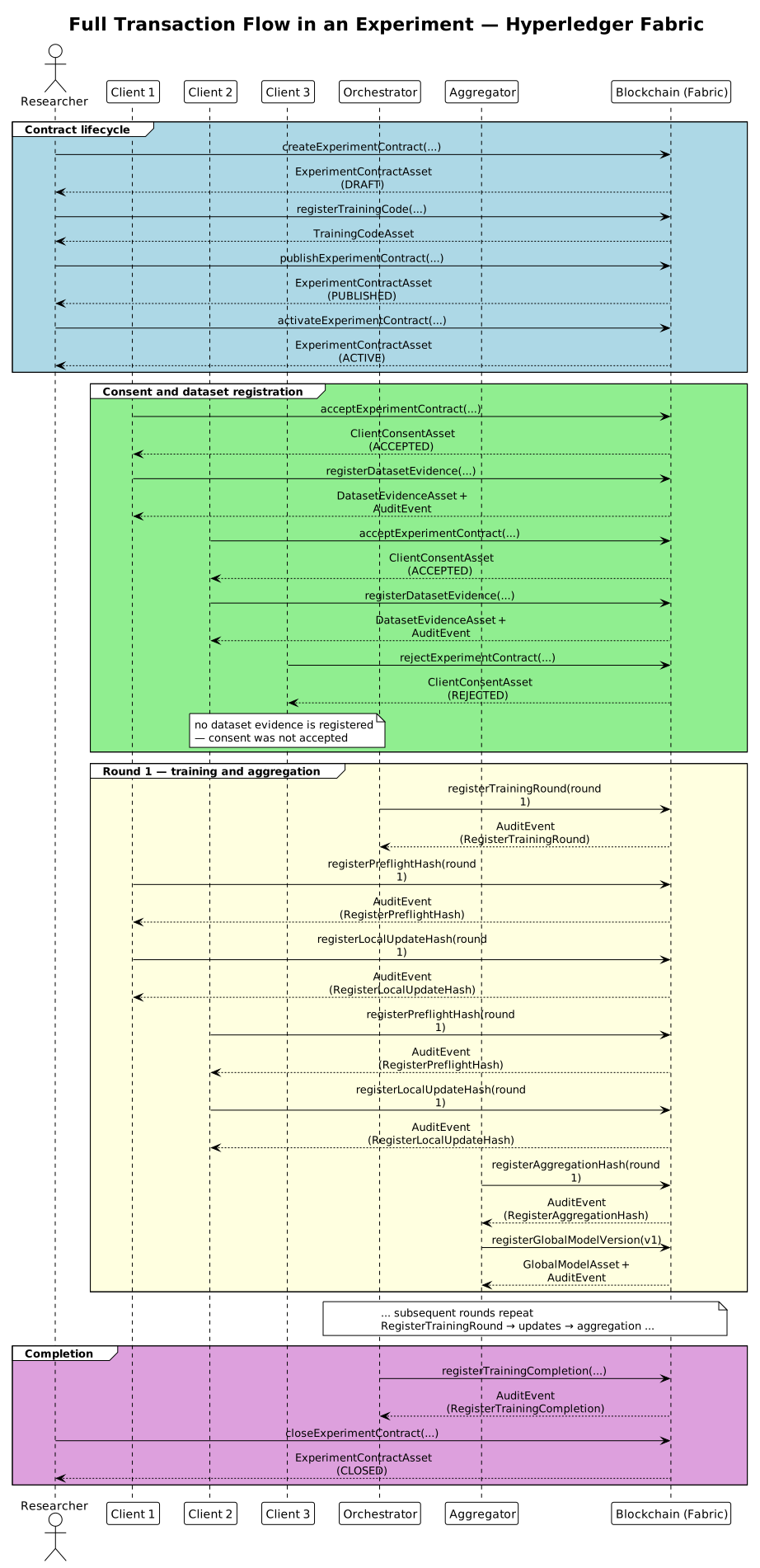
Full transaction flow in an experiment
The diagram below shows the chronological order of Fabric transactions throughout a complete experiment, including per-client dataset evidence registration (registerDatasetEvidence) right after consent is accepted:
Ver código-fonte PlantUML
    @startuml "Full Transaction Flow in an Experiment"
    !theme plain
    skinparam shadowing false
    skinparam sequenceMessageAlign center
    skinparam maxMessageSize 160

    title Full Transaction Flow in an Experiment — Hyperledger Fabric

    actor Researcher
    participant "Client 1" as Client1
    participant "Client 2" as Client2
    participant "Client 3" as Client3
    participant Orchestrator
    participant Aggregator
    participant "Blockchain (Fabric)" as FAB

    group #LightBlue Contract lifecycle
        Researcher -> FAB : createExperimentContract(...)
        FAB --> Researcher : ExperimentContractAsset (DRAFT)
        Researcher -> FAB : registerTrainingCode(...)
        FAB --> Researcher : TrainingCodeAsset
        Researcher -> FAB : publishExperimentContract(...)
        FAB --> Researcher : ExperimentContractAsset (PUBLISHED)
        Researcher -> FAB : activateExperimentContract(...)
        FAB --> Researcher : ExperimentContractAsset (ACTIVE)
    end

    group #LightGreen Consent and dataset registration
        Client1 -> FAB : acceptExperimentContract(...)
        FAB --> Client1 : ClientConsentAsset (ACCEPTED)
        Client1 -> FAB : registerDatasetEvidence(...)
        FAB --> Client1 : DatasetEvidenceAsset + AuditEvent

        Client2 -> FAB : acceptExperimentContract(...)
        FAB --> Client2 : ClientConsentAsset (ACCEPTED)
        Client2 -> FAB : registerDatasetEvidence(...)
        FAB --> Client2 : DatasetEvidenceAsset + AuditEvent

        Client3 -> FAB : rejectExperimentContract(...)
        FAB --> Client3 : ClientConsentAsset (REJECTED)
        note over Client3 : no dataset evidence is registered\n— consent was not accepted
    end

    group #LightYellow Round 1 — training and aggregation
        Orchestrator -> FAB : registerTrainingRound(round 1)
        FAB --> Orchestrator : AuditEvent (RegisterTrainingRound)

        Client1 -> FAB : registerPreflightHash(round 1)
        FAB --> Client1 : AuditEvent (RegisterPreflightHash)
        Client1 -> FAB : registerLocalUpdateHash(round 1)
        FAB --> Client1 : AuditEvent (RegisterLocalUpdateHash)

        Client2 -> FAB : registerPreflightHash(round 1)
        FAB --> Client2 : AuditEvent (RegisterPreflightHash)
        Client2 -> FAB : registerLocalUpdateHash(round 1)
        FAB --> Client2 : AuditEvent (RegisterLocalUpdateHash)

        Aggregator -> FAB : registerAggregationHash(round 1)
        FAB --> Aggregator : AuditEvent (RegisterAggregationHash)
        Aggregator -> FAB : registerGlobalModelVersion(v1)
        FAB --> Aggregator : GlobalModelAsset + AuditEvent
    end

    note over Orchestrator, FAB
      ... subsequent rounds repeat
      RegisterTrainingRound → updates → aggregation ...
    end note

    group #Plum Completion
        Orchestrator -> FAB : registerTrainingCompletion(...)
        FAB --> Orchestrator : AuditEvent (RegisterTrainingCompletion)
        Researcher -> FAB : closeExperimentContract(...)
        FAB --> Researcher : ExperimentContractAsset (CLOSED)
    end

    @enduml
Known limitations
-
Simulators do not model MSP, channels, or endorsement. The in-memory simulators (
ExperimentContractChaincode,ClientConsentChaincode,FederatedExperimentChaincode) implement the same business invariants as the real chaincodes, but do not model per-organization endorsement policies, channel isolation, Private Data Collections, or MSP certificate revocation. These aspects can only be tested with a real Fabric network (local in Docker containers or a staging environment). -
Legacy
EXPCEPTEDin old reads. The accepted consent status was historically written asEXPCEPTED(a typo forACCEPTED) both in the simulators and in the real chaincodes. Every new write usesACCEPTEDexclusively (canonical value); reads (getClientConsentStatus,listAcceptedClients) continue to accept both values so as not to break records written before the fix. SeeLedgerConstants.CONSENT_ACCEPTED/CONSENT_EXPCEPTEDand 02-chaincodes.md. -
Fabric bridge split across sessions (BL-178). As detailed in "Two bridge implementations to Fabric" above, only
ErgonomicRiskFederatedSessionparticipates in the process's sharedFabricGatewayLedgerMirrorviaFabricExperimentBridgeContext.EcgFederatedSession,HarFederatedSession,MimicV31FederatedSession, andMnistFederatedSessioncontinue to open their ownFabricCliLedgerMirror(legacy CLI), with their own environment configuration. This means that, today, the evidence for these four experiments is written to the real ledger through a different path (and with a different configuration surface —FABRIC_PEER_BIN/CORE_PEER_*instead ofFABRIC_GATEWAY_*) than the one used by the monitor itself. Not yet fixed; the decision on whether to migrate is left for a future review.
Chaincode deployment procedure (reference)
The chaincode is already deployed on the test-network. The procedure below is the reference for re-deployment in case of an update.
Prerequisites
- Test-network started:
./network.sh up createChannel -c federated-channel -ca - Fabric binaries at
/Users/josedaniel/hyperledger/fabric-samples/bin/ FABRIC_CFG_PATH=/Users/josedaniel/hyperledger/fabric-samples/config
1. Build the fat JAR
cd deploy/fabric/chaincode/federated-governance-java
# The shadow plugin 7.1.2 is required (8.x is incompatible with Gradle 9.3 in the fabric-javaenv container)
gradle shadowJar
# Produces: build/libs/federated-governance-chaincode-0.1.0.jar
2. Packaging
The package is generated from the pre-built fat JAR (not from source), to avoid building inside the Fabric Docker container:
# Staging dir with the JAR
STAGE=$(mktemp -d) && mkdir -p "$STAGE/src"
cp build/libs/federated-governance-chaincode-0.1.0.jar "$STAGE/src/chaincode.jar"

peer lifecycle chaincode package deploy/fabric/federated-governance-chaincode.tar.gz \
  --path "$STAGE" --lang java --label "federated-governance_1.0.0"
3. Install, approve, and commit
# Common variables
PKG=deploy/fabric/federated-governance-chaincode.tar.gz
CHANNEL=federated-channel
ORDERER_CA=<test-network>/organizations/ordererOrganizations/example.com/orderers/orderer.example.com/msp/tlscacerts/tlsca.example.com-cert.pem

# Org1
export CORE_PEER_LOCALMSPID=Org1MSP
export CORE_PEER_ADDRESS=localhost:7051
# (set CORE_PEER_MSPCONFIGPATH and CORE_PEER_TLS_ROOTCERT_FILE for Org1)
peer lifecycle chaincode install $PKG
peer lifecycle chaincode approveformyorg -o localhost:7050 --ordererTLSHostnameOverride orderer.example.com \
  --channelID $CHANNEL --name federated-governance --version 1.0.0 --package-id <id> --sequence 1 \
  --tls --cafile $ORDERER_CA

# Org2 (repeat install and approveformyorg with Org2 vars)

# Commit
peer lifecycle chaincode commit -o localhost:7050 --ordererTLSHostnameOverride orderer.example.com \
  --channelID $CHANNEL --name federated-governance --version 1.0.0 --sequence 1 \
  --tls --cafile $ORDERER_CA \
  --peerAddresses localhost:7051 --tlsRootCertFiles <tlsca-org1> \
  --peerAddresses localhost:9051 --tlsRootCertFiles <tlsca-org2>
The scripts/fabric-package-chaincode.sh script covers only the packaging step. The install/approve/commit steps are manual or via network.sh deployCC.